The Proposition Phase in Hi-Tech Sales

How to Win Enterprise Evaluations Without Losing Margin or Momentum
Learn how hi-tech companies master the Proposition Phase in complex B2B sales. Discover how to navigate procurement, strengthen differentiation, manage information gaps, and convert co-created solutions into winning enterprise proposals using 4steps2win.
In hi-tech sales, the Proposition Phase is where deals either become enterprise wins or disappear into procurement black holes.
You’ve built executive sponsorship, co-created a solution and understand the customer’s strategy.
Then the call comes.
Budget is approved, procurement takes over and formal proposals are requested.
Everything changes.
Why the Proposition Phase Feels Different in Hi-Tech
Hi-tech enterprise deals involve:
- Large budgets
- Technical scrutiny
- Compliance requirements
- Cross-functional evaluation
- Competitive pressure
Once budgets are formally allocated, financial frames become rigid.
The conversation shifts from:
Strategic partnership to competitive evaluation.
Flexibility decreases, information flow slows and decision criteria become formalized.
This transition is where many strong hi-tech vendors lose control.
The Three Success Factors That Determine Enterprise Wins

For hi-tech companies, these factors are especially critical.
1. Budget Intelligence Beyond the Number
In enterprise hi-tech sales, knowing the budget figure is not enough.
You must understand:
- Who controls flexibility
- How the budget was framed
- What outcomes justified allocation
- Where competitive room exists
Without budget intelligence, you either:
- Price yourself out
- Or win a deal that damages profitability .
Strong hi-tech teams map financial authority as carefully as they map technical architecture.
2. Requirements Mastery, Not Just Compliance
Enterprise procurement documents often contain long lists of requirements, but not all requirements are equal.
Some are must-haves and some are negotiable preferences.
High-performing hi-tech sellers:
- Influence requirements during earlier co-creation phases
- Elevate their differentiators into non-negotiable criteria
- Understand which elements drive real evaluation weight
When your unique capability becomes a required standard, you shift from competing on price to competing on value.
3. Relationship Leverage During Procurement
Formal procurement often restricts direct executive access but relationships built during executive sponsorship and co-creation remain critical assets.
Champions provide:
- Informal feedback
- Insight into evaluation shifts
- Competitive intelligence
- Early warning signals
In hi-tech environments, where evaluation complexity is high, this leverage becomes a decisive advantage.

The Hidden Risk: Information Asymmetry
In enterprise hi-tech evaluations, customers often control information flow.
They may:
- Limit visibility into competitor positioning
- Provide incomplete requirement clarity
- Withhold pricing context
Procurement professionals themselves cite lack of transparency as a key challenge, which creates asymmetry.
The strongest hi-tech teams don’t react to RFPs.
They prepare for them.
Internal Alignment Is the Real Differentiator
In complex hi-tech deals, proposals are not just sales documents, they’re organizational commitments.
Delivery teams have to validate feasibility, finance validates pricing logic and leadership understands negotiation boundaries.
Without internal alignment, you risk:
- Overpromising
- Underestimating delivery complexity
- Entering negotiation unprepared
With alignment, your proposal reflects confidence and credibility.
Enterprise buyers can feel the difference.
Late Entry in Hi-Tech Markets
Hi-tech markets move fast. Sometimes you enter an evaluation late.
Late entry requires disciplined strategic choice.
You should assess:
- Competitive positioning
- Relationship depth
- Resource investment versus likely return
Not every RFP deserves equal effort.
Strategic selectivity protects margin and delivery quality.
From Proposal Chaos to Predictable Wins
The proposition phase should not be improvised.
Systematic excellence should be build as follows:
- Proposition readiness reviews
- Cross-functional proposal teams
- Competitive intelligence networks
- Budget and requirement mapping before formal submission
When treated as a structured capability, the proposition phase becomes repeatable.
Repeatability drives win rates and margin protection.
What This Means for Hi-Tech Leaders
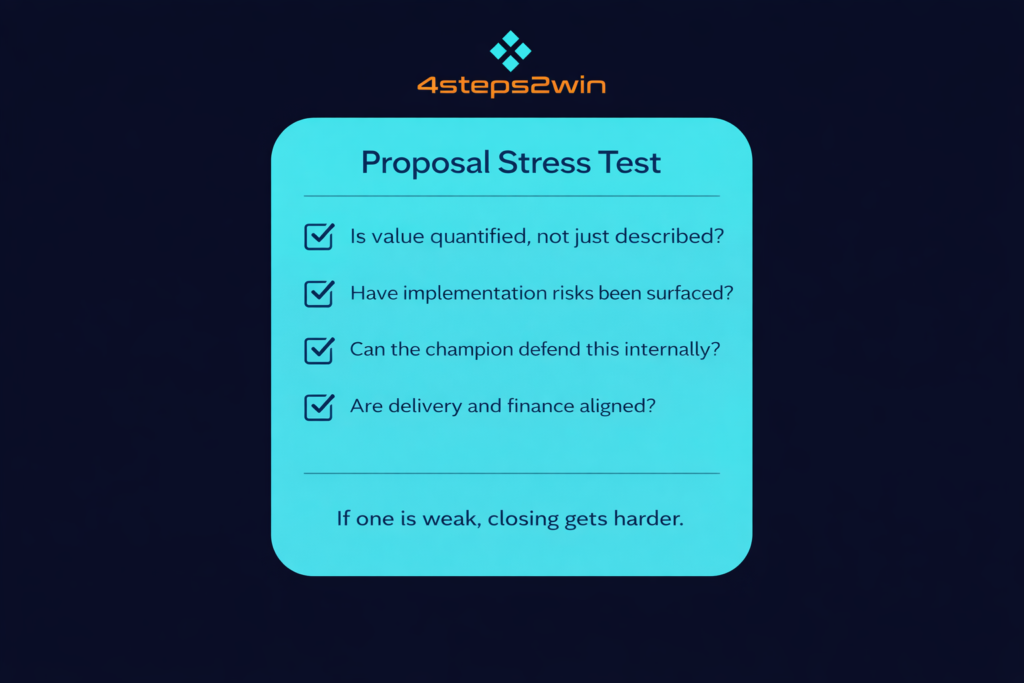
If you’re leading a hi-tech sales team, ask:
- Are we consistently gathering budget intelligence early?
- Have we shaped requirements during co-creation?
- Are delivery and finance aligned before submission?
- Do we treat RFPs as reactive events or strategic milestones?
The proposition phase exposes the quality of your earlier work.
It rewards preparation and punishes assumption.
Final Thought
In complex B2B hi-tech sales, great technology gets you shortlisted and mastering the Proposition Phase gets you selected.
Translate co-creation into competitive advantage.
Align internally before committing externally.
Manage information asymmetry intelligently.
Strengthen differentiation beyond features.
When done well, enterprise wins become predictable.
📘 Learn more at: www.mybook.to/4steps2win.
💬 Book a free consultation: 4steps2win.com/contact/