The Co-Creation Journey in Hi-Tech Sales

Learn why co-creation is critical in hi-tech B2B sales and how building solutions with customers increases trust, speeds decisions, and helps enterprise deals scale using the 4steps2win approach.
Hi-tech companies rarely struggle with ideas, they struggle with adoption.
Great products.
Strong engineering.
Compelling demos.
Yet enterprise deals still stall, pilots don’t scale, and buying cycles stretch far longer than expected.
The issue usually isn’t technical.
It’s that the solution was designed in isolation, then presented to a customer who had to internalise it, defend it, and justify it alone.
That’s where co-creation changes everything.
Why Traditional Selling Breaks Down in Hi-Tech Sales
In complex hi-tech environments, customers aren’t just buying software or platforms. They’re buying change.
Change to:
- how teams work
- how systems integrate
- how risk is managed
- how value is delivered
When risk is high, customers don’t want finished answers, they want shared ownership.
Traditional selling puts all the thinking on the supplier and all the justification on the customer. That imbalance creates resistance, even when the solution is strong.
Co-creation corrects that imbalance.
What Co-Creation Really Means
Co-creation doesn’t mean giving away your expertise.
It means applying it with the customer, not at them.
In hi-tech sales, co-creation is the process of:
- exploring the problem space together
- shaping solution concepts collaboratively
- validating assumptions early
- aligning success criteria before proposals appear
When done well, the solution stops feeling like “your product” and starts feeling like their initiative.
That shift matters more than most sales teams realise.

Why Co-Creation Works So Well in Hi-Tech Deals
1. It reduces perceived risk
Enterprise buyers are cautious by nature. When customers help shape the solution, they understand the trade-offs, constraints, and implications early.
That transparency lowers fear and builds confidence.
2. It builds internal advocates naturally
People defend what they help create.
Co-creation turns stakeholders into contributors, contributors become internal advocates who in turn accelerate decisions when resistance appears later.
3. It surfaces the real blockers early
In hi-tech sales, objections often appear late because no one asked the right questions early.
Co-creation brings concerns forward while there’s still time to address them.
4. It shifts the conversation from features to outcomes
Customers don’t buy technology, they buy what technology enables.
Co-creation keeps the focus on:
- business impact
- operational improvement
- strategic outcomes
That’s the language executives and buying committees respond to.

The Co-Creation Journey in Practice
Co-creation isn’t a workshop or a single meeting, it’s a journey with clear phases.
1. Shared understanding
This is where you explore:
- market pressures
- business objectives
- current challenges
- constraints and dependencies
The goal isn’t to impress, it’s to understand.
Useful questions include:
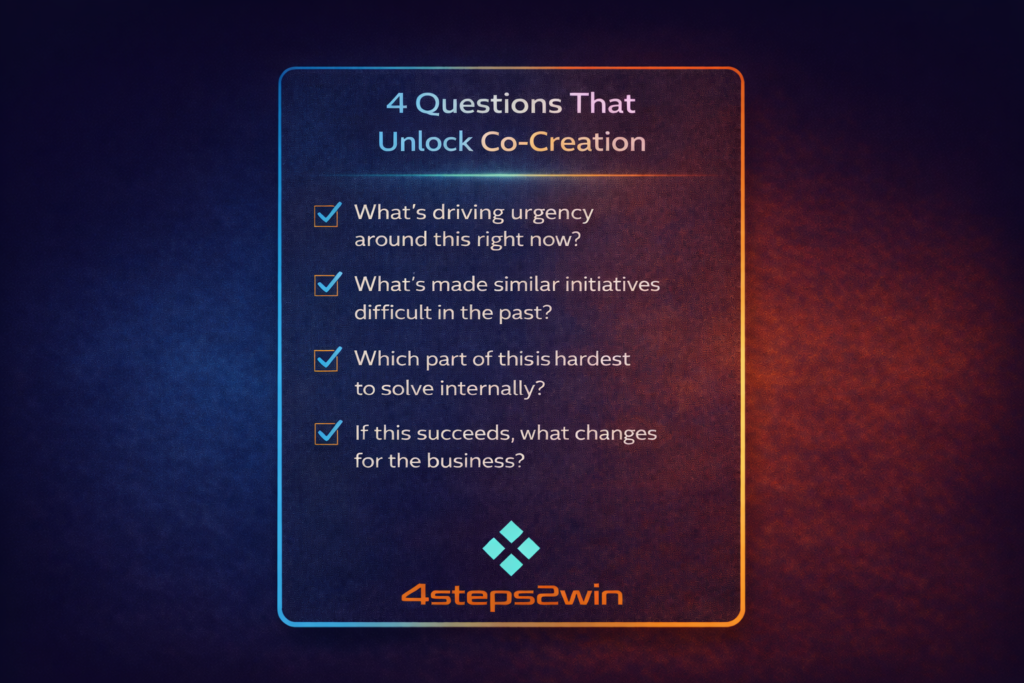
- What’s driving urgency around this right now?
- What would success look like from your perspective?
- What’s made similar initiatives difficult in the past?
2. Joint problem framing
Instead of jumping to solutions, you frame the problem together.
This often sounds like:
- If we step back, what are we really trying to change here?
- Which part of this is hardest to solve internally?
This phase is where trust starts to form.
3. Collaborative solution shaping
Now you introduce ideas, but as hypotheses, not conclusions.
You might say:
- One approach we’ve seen work is… how would that land here?
- If we explored this direction, what concerns would we need to solve first?
Customers feel respected, not sold to.
4. Validating value together
This is where co-creation becomes commercial.
Instead of presenting ROI, you build it together:
- What outcomes matter most
- What success metrics make sense
- What assumptions need testing
By the time proposals appear, the value story is already agreed.
A Hi-Tech Example
A hi-tech company selling an AI-driven analytics platform initially positioned it around performance and architecture.
The customer liked the demo but hesitated.
Through co-creation, the conversation shifted to how the platform could help leadership scale decision-making without increasing headcount.
Once the solution was framed around strategic scale and operational confidence, stakeholders leaned in. The project moved from pilot to priority because it was no longer about technology, it was about enabling the business to grow safely.
Common Co-Creation Mistakes to Avoid
- Treating co-creation as a single session
- Over-customising before value is validated
- Jumping to solution too early
- Excluding key stakeholders
- Confusing agreement with ownership
Co-creation works when it’s structured, intentional, and ongoing.
Why Co-Creation Accelerates Decisions
When customers help build the solution:
- alignment happens earlier
- objections surface sooner
- confidence increases
- decisions feel safer
By the time you reach proposals and closing, you’re not asking customers to decide on something new. You’re asking them to commit to something they already helped shape.
That’s why co-creation isn’t a nice-to-have in hi-tech sales.
It’s a competitive advantage.
Final Thought
If your deals feel slow, ask yourself:
- Who helped shape this solution?
- Who feels ownership internally?
- Who would defend this if challenged tomorrow?
If the answers are unclear, co-creation hasn’t gone far enough.
At 4steps2win
At 4steps2win, we help hi-tech sales teams use co-creation to reduce risk, build trust, and accelerate enterprise decisions by designing solutions with customers, not for them.
📘 Learn more at: www.mybook.to/4steps2win
💬 Book a free consultation: www.4steps2win.com/contact/