How to Build a Value Proposition That Customers Actually Believe In

Discover how to build a co-created value proposition that gains customer trust, accelerates decisions, and strengthens your competitive position using the 4steps2win value framework.
Why Most B2B Value Propositions Fail
Ask any sales professional to describe their value proposition and you will often hear a list of features, benefits, or differentiators. On paper these statements look impressive. In practice they collapse under the weight of customer reality.
Most value propositions fail because they are supplier centric, not customer created. They reflect what the supplier wants to talk about rather than what the customer needs to solve. They are built on assumptions, rather than joint discovery. And they often ignore internal dynamics that shape real decision making.
In complex B2B environments, this is a critical mistake. Customers aren’t simply comparing solutions, they’re navigating political tensions, capability gaps, performance pressures, and internal risk perceptions. A winning value proposition has to address all of these.
This is why co-created value is at the heart of Step 2 in the 4steps2win methodology. As explained in Chapter 5 of our book, successful value propositions aren’t delivered. They’re developed together, shaped through conversation, validation, and contribution from both sides.
The Strategic Shift: From Selling Value to Co-Creating It
Traditional sales approaches assume that suppliers define value and customers accept or reject it. Modern buying doesn’t work this way. Senior leaders often define strategic priorities at the top level, but operational teams must interpret these goals into plans, metrics, and capabilities. In this translation process, capability gaps appear. These are the spaces where co-creation becomes possible.
Customers don’t simply want a solution, they want a partner who helps them bridge these capability gaps in a way that advances their internal success. This requires a shift in posture. Instead of being a vendor who presents ideas, you have to become a contributor who builds ideas together with the customer.
Co-created value propositions achieve three outcomes that traditional approaches never deliver:
- Higher credibility because they reflect the customer’s language and metrics.
- Stronger internal advocacy because stakeholders defend what they helped design.
- Greater differentiation because competitors can’t replicate co-created insight.
When a customer begins to refer to your solution as our solution, you’ve reached the highest form of value acceptance. This psychological shift is one of the strongest predictors of deal success.
The 4steps2win Value Proposition Framework
The 4steps2win methodology provides a structured eight part framework for building a value proposition that customers believe in. This framework is split into two halves: customer understanding and supplier contribution.
Together they create a complete picture of value that’s both relevant and credible.

Customer Understanding Components
1. Market Trends & Drivers
Understanding external pressures that shape your customer’s world is essential. Market dynamics, regulatory changes, new competitive threats, and industry disruptions all influence urgency. Demonstrating awareness of these drivers shows your proposition isn’t generic, it’s grounded in the customer’s strategic reality.
2. Business Objectives
Your customer’s goals must shape your approach. Whether they aim to increase efficiency, reduce risk, improve customer experience, or accelerate growth, your value story must align directly with these objectives. You can’t create value without knowing where the business wants to go.
3. Current Challenges
Customers rarely articulate their real challenges in early conversations. Co-creation means identifying root causes, capability limitations, political tensions, and operational constraints. When you reflect these accurately in your value proposition, you prove that you understand them better than competitors who only scratch the surface.
4. Success Metrics
Your solution must align to measurable outcomes. These could include performance levels, customer satisfaction, compliance standards, or operational availability. Success metrics allow the customer to quantify expected value and create a shared definition of success.
Supplier Contribution Components
5. Solution Concepts
Solution concepts must be shaped by what you’ve learned, not by your internal product agenda. In co-creation, you offer ideas, test hypotheses, adjust, refine, and ensure the customer sees feasibility and relevance.
6. Evidence and Capabilities
Your value story must be backed by proof. This includes reference cases, technical feasibility, delivery track record, and expertise. Evidence reduces emotional risk and builds confidence.
7. Competitive Strengths
Your differentiation must be clear, believable, and tied directly to customer needs. Avoid generic claims and show where your approach is uniquely positioned to support the customer’s success. Your competitive strength should be a natural extension of the co-created solution.
8. Next Steps
The most underrated part of value propositions is clarity about what happens after alignment. Co-created next steps show commitment from both sides and give the customer a roadmap for continued progress.
How These Eight Components Work Together
The eight components don’t stand alone. They form what we describe as a value mesh. Customer understanding creates relevance and supplier contribution creates credibility.
The connector between the two sides is Expected Business Value which is the shared outcome that both parties commit to achieving. It reflects how the solution supports the customer’s objectives, reduces risk, and delivers measurable improvement.
Expected Business Value is the anchor that allows decision-making teams to justify investment, build consensus, and gain executive approval.
Why Co-Created Value Propositions Win
They build solution ownership
When customers help create the value story, they internalize it. They repeat it during internal meetings and defend it against objections. Sales success increases significantly when customers feel ownership of the solution concept.
They reduce internal resistance
Political tension is a hidden barrier in complex deals. Co-created value propositions acknowledge competing interests and help align diverse stakeholders reducing hidden resistance and accelerating consensus.
They increase implementation confidence
Decision-makers want to believe the supplier can deliver. Co-created value propositions show that delivery planning started long before the contract which builds trust and confidence in execution capability.
They differentiate beyond features
Competitors can copy features but they can’t copy your relationship, your insight, or your co-creation journey. This creates a sustainable advantage.
How to Build a Value Proposition Customers Believe, Step by Step
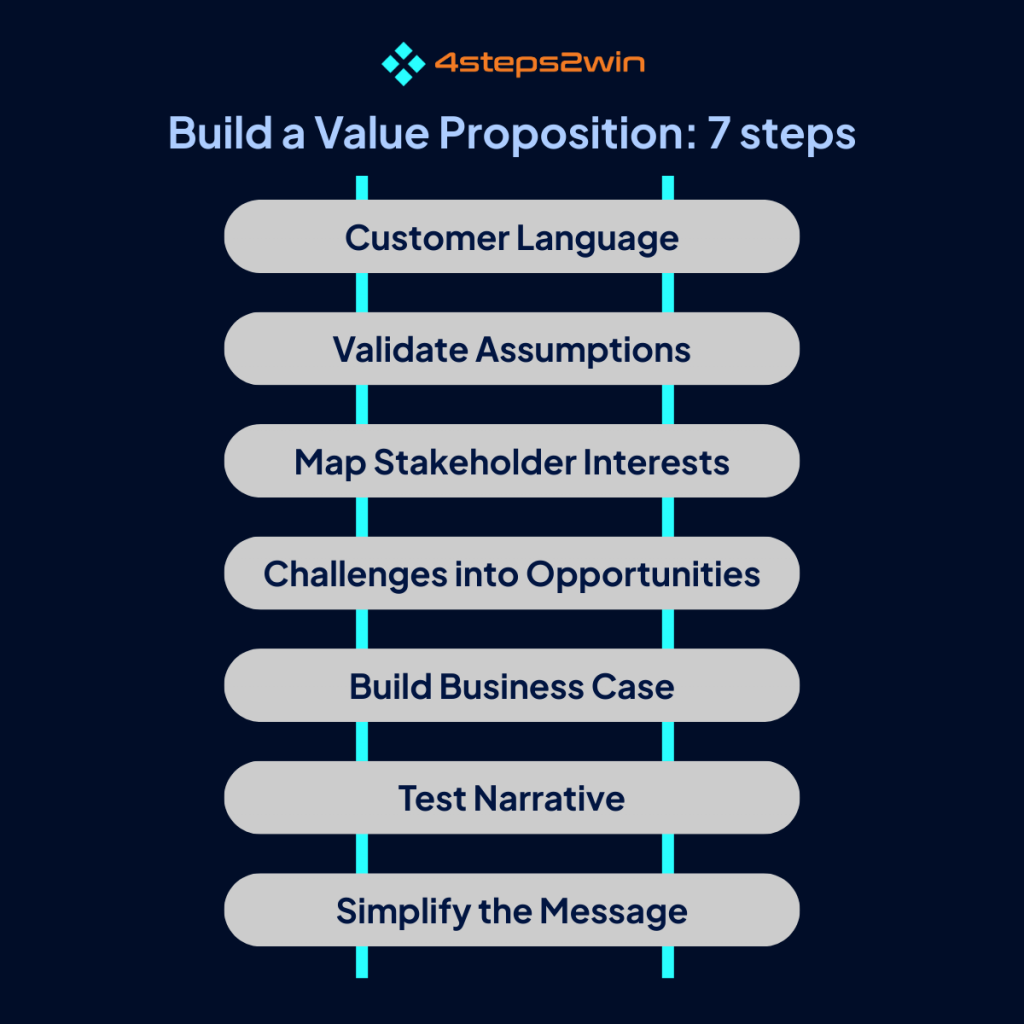
Here is a practical approach drawn directly from Chapter 5 of our methodology.
1. Start with customer language
Mirror the customer’s vocabulary and internal terminology. This helps them feel that the value story came from within their organisation.
2. Validate assumptions continuously
Your early assumptions will almost always be incomplete. Regular validation ensures your value story evolves with new insights.
3. Map stakeholder interests
Different stakeholders care about different outcomes. Build value statements for executives, managers, evaluators, and users so that you can speak to all decision-making roles.
4. Convert challenges into opportunity themes
Reframe operational issues as strategic opportunities that your solution enables. This transforms your approach from a problem fixer to a strategic partner.
5. Build business case logic collaboratively
The most convincing business cases are co-created. When customers contribute data, provide feedback, and refine assumptions, the credibility increases dramatically.
6. Test the narrative with a champion
Your internal champion will be the first to tell you if the value story is strong enough to survive internal review.
7. Simplify the message
A decision-maker should be able to summarize your value proposition in one or two sentences. If they can’t, the story isn’t yet clear enough.
Example: When Co-Created Value Changed the Outcome
A technology supplier entered a competitive evaluation with little differentiation. Instead of pushing features, the team followed the 4steps2win approach and worked with the customer to uncover a capability gap that no competitor had identified. Together they designed a phased solution that aligned perfectly with the customer’s operational constraints.
The customer champion later said, “This feels like something we built, not something we bought.”
Once that sentiment surfaced, the vendor became the preferred partner and the deal advanced quickly.
Value Isn’t Claimed. Value Is Co-Created.
In complex B2B environments, customers don’t want to be convinced, they want to be understood. They don’t want polished slides, they want partnership.
A value proposition that’s co-created does more than persuade.
It aligns. It reassures. It energises. It builds internal momentum.
When crafted through insight, collaboration, and structure, your value proposition becomes a strategic tool that accelerates the Proposition Phase and strengthens your competitive advantage.
At 4steps2win
We help sales teams build value propositions that move beyond messaging and become co-created business cases that customers trust, believe in, and defend.
📘 Learn more at: www.4steps2win.com
💬 Book a free consultation: 4steps2win.com/contact/