Engaging with the Customer’s Decision-Making Team: How Complex B2B Deals Really Get Won

Learn how to engage the full customer decision-making team in complex B2B sales. Discover the five roles that shape decisions and how to build alignment, reduce risk, and guide customers to confident commitment using the 4steps2win approach.
Why Single-Threaded Selling Breaks in Complex Sales
Complex B2B deals rarely fail because the solution is wrong.
They fail because the right people were never aligned at the same time.
Many sales professionals still rely on one strong relationship and hope it will carry the deal through. That approach can work in simple transactions, but it quickly collapses when decisions involve multiple functions, priorities, and internal politics.
In the 4steps2win methodology, engaging with the customer’s decision-making team is a core capability. It’s the shift from reacting to decisions toward actively guiding how those decisions are formed.
Winning complex deals means understanding not only who is involved, but why they are involved and what success looks like for each of them.
How Decision-Making Teams Actually Form
Decision-making teams don’t appear because a formal buying process starts.
They form when a customer recognises that a strategic initiative can’t be delivered by one person or one function alone.
Executives define direction.
Managers translate strategy into operational responsibility.
Capability gaps surface.
Cross-functional stakeholders are nominated to evaluate feasibility, risk, and impact.
At this stage, the customer isn’t looking for a vendor.
They’re looking for help navigating complexity and uncertainty.
Sales professionals who understand this stop pitching and start supporting the customer’s internal decision process. This is where trust and influence begin.
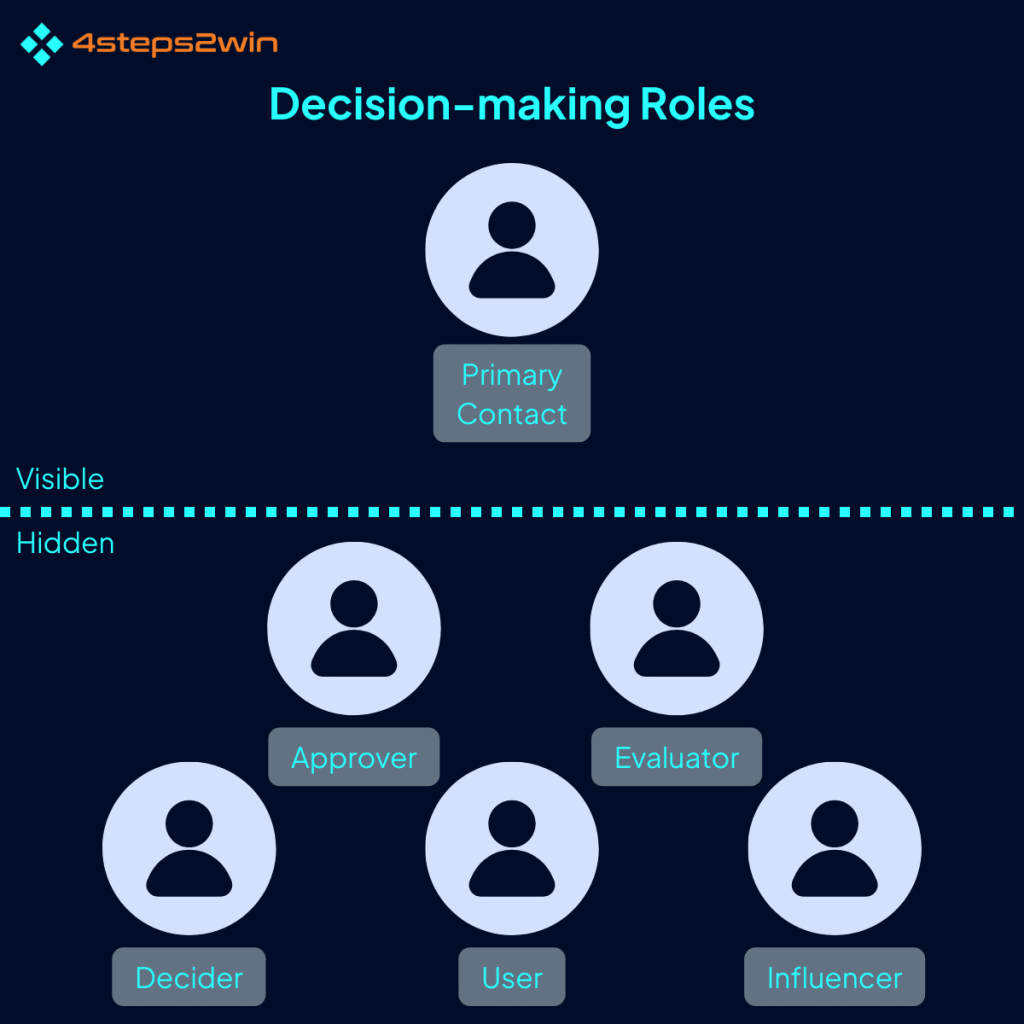
The Five Roles That Shape Every Complex Decision
Every complex B2B decision involves five distinct roles. Job titles vary, but the roles are consistent across industries.
1. The Approver
Approvers control budget authority and strategic alignment.
They’re focused on business impact, long-term value, and organisational risk.
If approvers don’t see how your solution supports strategic objectives, the deal stalls quietly, often without feedback.
Your responsibility is to connect value to outcomes they care about and reduce perceived risk.
2. The Decider
Deciders are accountable for implementation success.
They balance performance expectations, timelines, cost, and internal coordination.
They often feel the most pressure because failure reflects directly on them.
Winning their confidence requires clarity, feasibility, and delivery credibility.
3. The Evaluator
Evaluators assess whether the solution will actually work.
They focus on technical fit, legal constraints, compliance, security, and operational risk.
They might not make the final decision, but they can easily slow or block progress if concerns remain unresolved.
Ignoring evaluators is one of the most common causes of late-stage delays.
4. The User
Users interact with the solution day to day.
They judge usability, workflow impact, and practicality.
User resistance rarely shows up early. It appears later as “concerns,” “feedback,” or adoption challenges.
Engaging users early reduces silent resistance and improves long-term success.
5. The Influencer
Influencers shape opinions without formal authority.
They might be senior specialists, internal advisors, or respected voices across the organisation.
Influencers often raise issues others avoid and strongly affect perception behind the scenes.
Building trust with influencers gives you early insight into hidden dynamics.
Why Multi-Stakeholder Engagement Is a Competitive Advantage
Engaging only one role creates unnecessary risk.
Any single stakeholder can delay or derail a deal if their interests aren’t addressed.
Engaging across the decision-making team creates three major advantages:
- Risk reduction No single relationship failure can stop progress.
- Information advantage You uncover concerns, objections, and internal dynamics early.
- Emotional preference Stakeholders feel supported rather than sold to.
When customers feel supported through complexity, preference forms naturally.
Mapping Stakeholders Is Not Enough
Many teams create stakeholder maps that list names and titles.
That’s a starting point, not a solution.
Effective engagement requires power validation.
You need to understand:
- Who influences final decisions.
- Who speaks last in meetings.
- Whose concerns carry weight.
- Who feels threatened by change.
- Who personally benefits from success.
This insight comes from curiosity, listening, and observation, not spreadsheets.
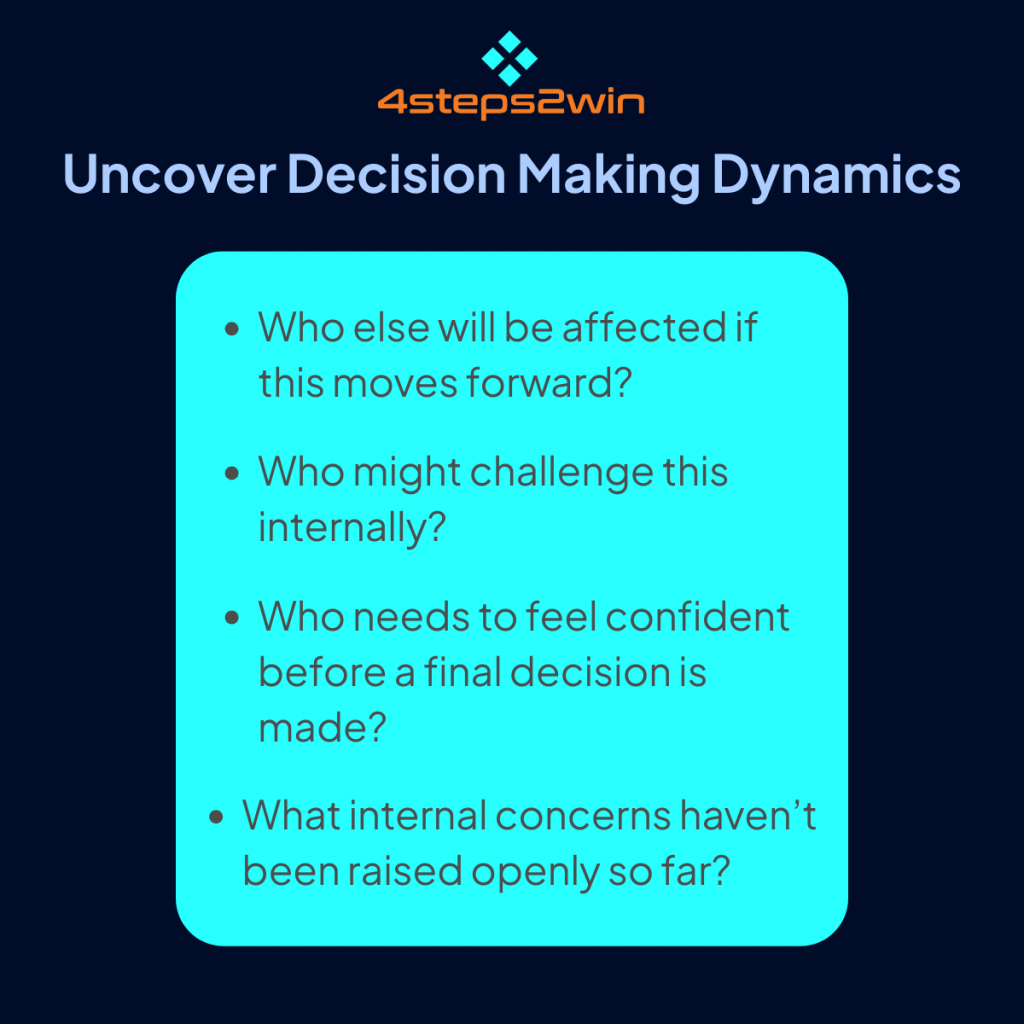
Questions like these uncover reality:
- Who else will be affected if this moves forward.
- Who might challenge this internally.
- Who needs to feel confident before approval.
- Who would benefit most if this succeeds.
Building Role-Specific Value Narratives
A single value proposition cannot serve all stakeholders.
Each role evaluates value differently:
- Approvers look for strategic impact.
- Deciders want execution confidence.
- Evaluators focus on risk mitigation.
- Users care about usability.
- Influencers want credibility and recognition.
Your task is to translate the same core value into role-specific narratives without losing consistency.
When stakeholders repeat your value story in their own words, alignment is forming.
Navigating Internal Politics Without Taking Sides
Internal politics aren’t a problem.
Pretending they don’t exist is.
Competing priorities, personal agendas, and departmental tensions are normal in complex organisations.
You don’t need to choose sides.
You need to acknowledge reality and help align interests.
Effective techniques include:
- Facilitating joint workshops.
- Reframing threats as shared challenges.
- Creating common success metrics.
- Documenting agreements to prevent backtracking.
When people feel protected rather than exposed, resistance softens.
Why Champion Networks Beat Single Champions
Relying on one champion is fragile.
Building a network of champions is resilient.
Champions across hierarchies provide:
- Multiple perspectives.
- Early warning signals.
- Internal advocacy.
- Protection against political shifts.
Champions aren’t created through flattery.
They’re created by helping people succeed internally.
A true champion gains credibility by working with you.
Taking Responsibility for the Customer’s Decision Process
One of the most important mindset shifts in this chapter is responsibility.
In complex sales, customers often struggle to organise their own decision process.
They face unclear roles, conflicting opinions, and pressure from leadership.
Sales professionals who win take responsibility for guiding the decision forward.
This doesn’t mean pushing.
It means structuring conversations, clarifying next steps, and helping the customer progress with confidence.
When customers feel supported rather than rushed, decisions accelerate.
Common Mistakes That Slow Deals Down
- Assuming enthusiasm equals alignment.
- Treating procurement as an obstacle.
- Ignoring users until late stages.
- Using the same message for everyone.
- Avoiding difficult conversations.
- Waiting for the customer to organise themselves.
Each of these increases risk and delays momentum.
Engaging the Decision-Making Team Is a Leadership Skill
This step isn’t about persuasion.
It’s about leadership.
You’re helping a group of people with different goals arrive at a shared decision.
That requires empathy, structure, and confidence.
When done well, engaging the decision-making team leads to:
- Faster decisions.
- Stronger relationships.
- Better implementations.
- Long-term partnerships.
At 4steps2win
At 4steps2win, we help sales professionals engage decision-making teams with clarity, structure, and confidence.
Our methodology equips teams to navigate complexity, build alignment, and guide customers toward decisions they trust.
📘 Learn more at: www.4steps2win.com
💬 Book a free consultation: 4steps2win.com/contact/