Roadmap to Advance Decisions – Why Good Deals Stall and How to Move Them Forward with Clarity

A practical breakdown of how to advance decisions in complex B2B sales using the 4steps2win roadmap. Learn why deals stall and how to create momentum across customer and internal decision-making teams.
You’ve probably experienced this before.
The customer likes you, the value proposition resonates, stakeholders are engaged and yet nothing moves.
Weeks pass. Meetings repeat. Decisions drift.
This isn’t a relationship problem, it’s a decision-making problem.
In complex B2B sales, deals don’t stall because people say no. They stall because nobody is actively guiding the next decision forward.
Winning requires more than influence or persuasion. It requires a clear roadmap that advances decisions on both sides of the table.
Why Decisions Don’t Move by Themselves
In simple sales environments, decisions follow a linear path.
In complex B2B environments, they don’t.
Customers are navigating internal priorities, politics, risk, budget ownership, and personal accountability. At the same time, your own organisation is making internal decisions about resource allocation, deal priority, and leadership support.
This creates a hidden challenge:
Every deal has two decision systems running in parallel.
One inside the customer organisation.
One inside your own.
If you manage only one of them, momentum breaks.
The Core Idea Behind the Roadmap to Advance Decisions
The roadmap to advance decisions gives sales professionals a way to see and manage both decision systems at the same time.
It’s not a sales stage model, it’s a visibility and alignment model.
The roadmap helps you answer three critical questions at any point in a deal:
- Who is actively involved on the customer side, and how committed are they?
- Who is actively involved internally, and how invested are they?
- What specifically needs to happen next to move both sides forward together?
When those three elements are aligned, decisions accelerate naturally.
When they aren’t, deals slow down regardless of how good the solution is.
The Two Decision Matrices You’re Always Managing
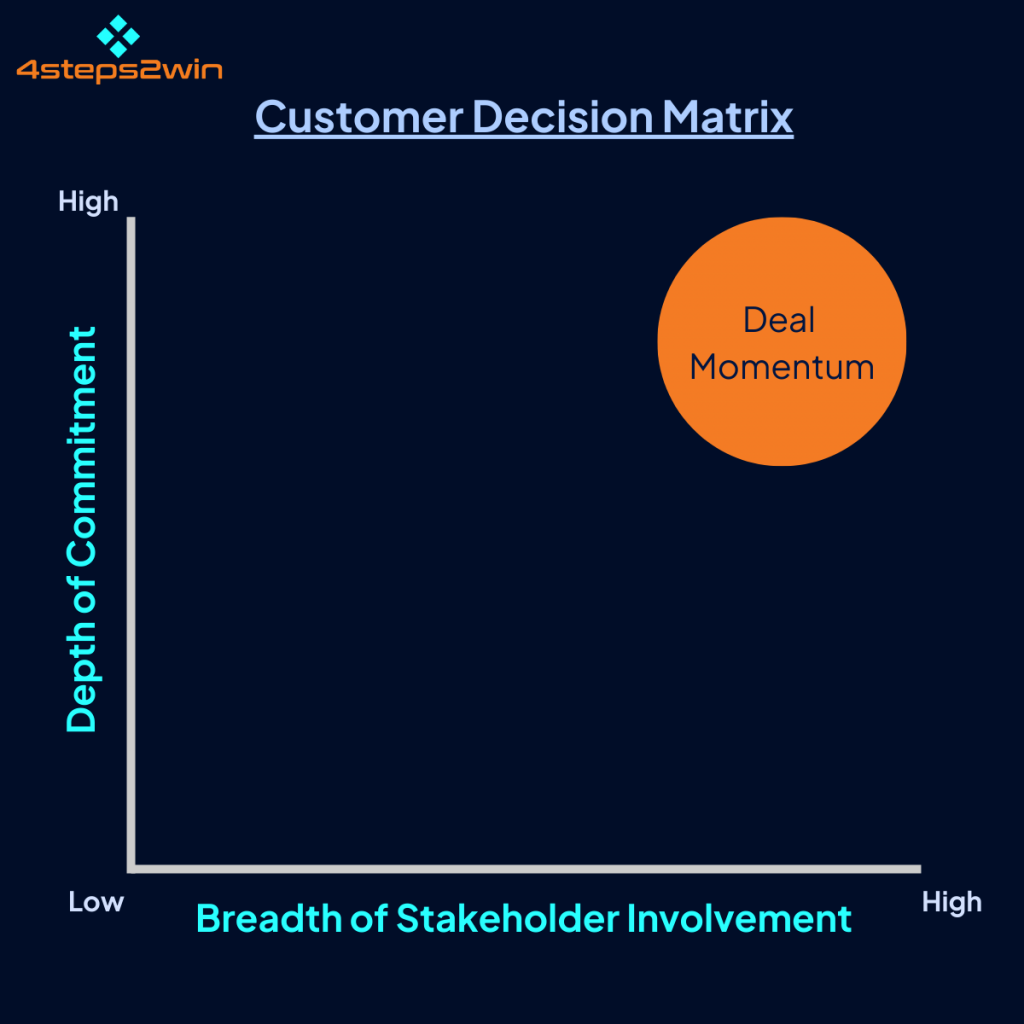
The Customer Decision Matrix
This view focuses on two dimensions:
- Breadth of stakeholder involvement Are you engaged with all relevant decision-making roles, or just a small group?
- Depth of commitment Are stakeholders simply interested, or are they actively investing time, energy, and credibility?
A deal may look healthy on the surface but still be fragile if:
- Engagement is narrow
- Commitment is verbal rather than behavioural
- Support hasn’t been tested through real co-creation
The roadmap forces you to be honest about this reality.
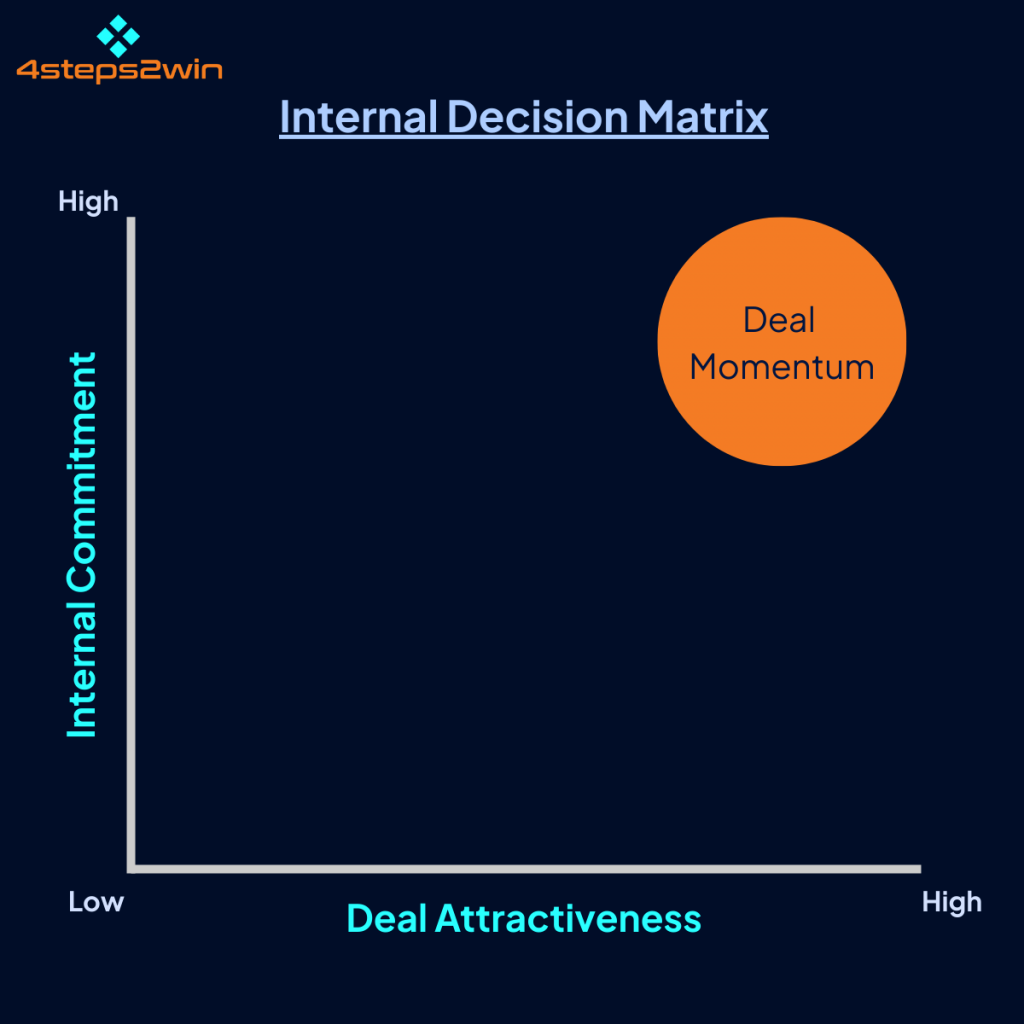
The Internal Decision Matrix
At the same time, every deal competes internally for attention and resources.
The internal matrix looks at:
- Who inside your organisation is actively involved
- How attractive the deal is compared to other opportunities
Weak internal commitment shows up quickly:
- Slow response times
- Limited executive access
- Generic proposals
- Underpowered delivery planning
Customers can sense this immediately.
Strong customer momentum with weak internal support creates risk.
Strong internal enthusiasm with weak customer commitment creates false confidence.
The roadmap exists to prevent both.
How Deals Actually Move Forward
Deals don’t advance because of activity, they advance because of validated decisions.
The roadmap encourages sales professionals to stop asking:
“What’s the next meeting?”
And start asking:
“What decision does this meeting need to enable?”
Progress happens when:
- A new stakeholder is engaged with purpose
- A value assumption is validated
- A risk is surfaced and addressed
- A commitment is made and acted upon
Each of these moves the deal forward.
Without them, meetings become motion without momentum.
Five Predictable Roadblocks and How to Navigate Them
The same obstacles appear in almost every complex deal.
Priority shifts
Customer focus changes. The roadmap forces regular revalidation so you can reposition value instead of reacting too late.
Stakeholder changes
People move roles or leave. Multi-threaded engagement reduces dependency on any one individual.
Competitive disruption
Competitors appear late with aggressive moves. Strong decision alignment makes disruption harder to absorb.
Budget constraints
Budgets tighten or get redirected. Early alignment helps you reframe investment before procurement dominates.
Implementation anxiety
Fear of execution slows decisions. Early planning builds confidence before contracts are signed.
None of these are exceptional, they’re normal.
What matters is whether you anticipate them or react after momentum is lost.
What This Means for Sales Leaders
For sales leaders, the roadmap changes pipeline conversations completely.
Instead of asking:
“When will this close?”
You can ask:
- Where is customer commitment strong and where is it weak?
- Where do we lack internal alignment?
- What single action would move this deal forward right now?
This turns pipeline reviews into decision reviews.
It replaces optimism with clarity.
Why This Roadmap Changes Outcomes
Sales professionals don’t lose deals because they lack effort, they lose deals because they don’t manage decisions deliberately.
The roadmap to advance decisions:
- Creates transparency where there’s usually guesswork
- Aligns customer and supplier momentum
- Replaces hope with intent
- Turns complexity into a navigable structure
When both organisations move forward together, closing becomes a natural consequence rather than a forced event.
Final Thought
If a deal feels stuck, it probably is.
Not because the customer said no, but because no one owns the next decision.
A clear roadmap fixes that.
📘 Learn more at: www.4steps2win.com
💬 Book a free consultation: www.4steps2win.com/contact/