Closing the Deal: Orchestrating Confidence, Commitment, and Consensus

Master the final step of the 4steps2win methodology. Learn how to orchestrate procurement, business, and project stakeholders, transform objections into progress, and turn co-created value into real customer commitment.
Closing Is Not a Moment. Closing Is an Orchestration.
After months of executive sponsorship, co-creation, and building a winning proposition, everything converges in the closing phase. This is where competing priorities, personal agendas, and organizational politics all surface at once.
Procurement says your price is too high.
Business leaders say they need your solution urgently.
Project managers worry about implementation risks.
You’re not just closing a deal.
You’re orchestrating the alignment of three groups with completely different definitions of success.
This is Step 4 in the 4steps2win approach, and its importance cannot be overstated. As the chapter highlights, closing requires a different skillset from earlier phases. It demands strategic balance, emotional intelligence, and the ability to create consensus where natural tension exists.
The Challenge: Three Stakeholder Groups, Three Priorities
Your success depends on harmonizing three groups that often see the world through conflicting lenses.
1. Procurement
Their priorities center on cost optimization and policy compliance.
To them, price is risk.
2. Business Managers
They care about capability, performance, and achieving strategic objectives.
To them, value is opportunity.
3. Project Managers
They focus on feasibility, risk mitigation, and integration into existing operations.
To them, execution is reality.
These groups naturally pull in different directions.
Closing excellence means balancing them, not defeating them.
Research reinforces this. B2B firms that successfully manage cross-functional alignment achieve significantly higher close rates compared to those stuck in siloed conversations.¹³
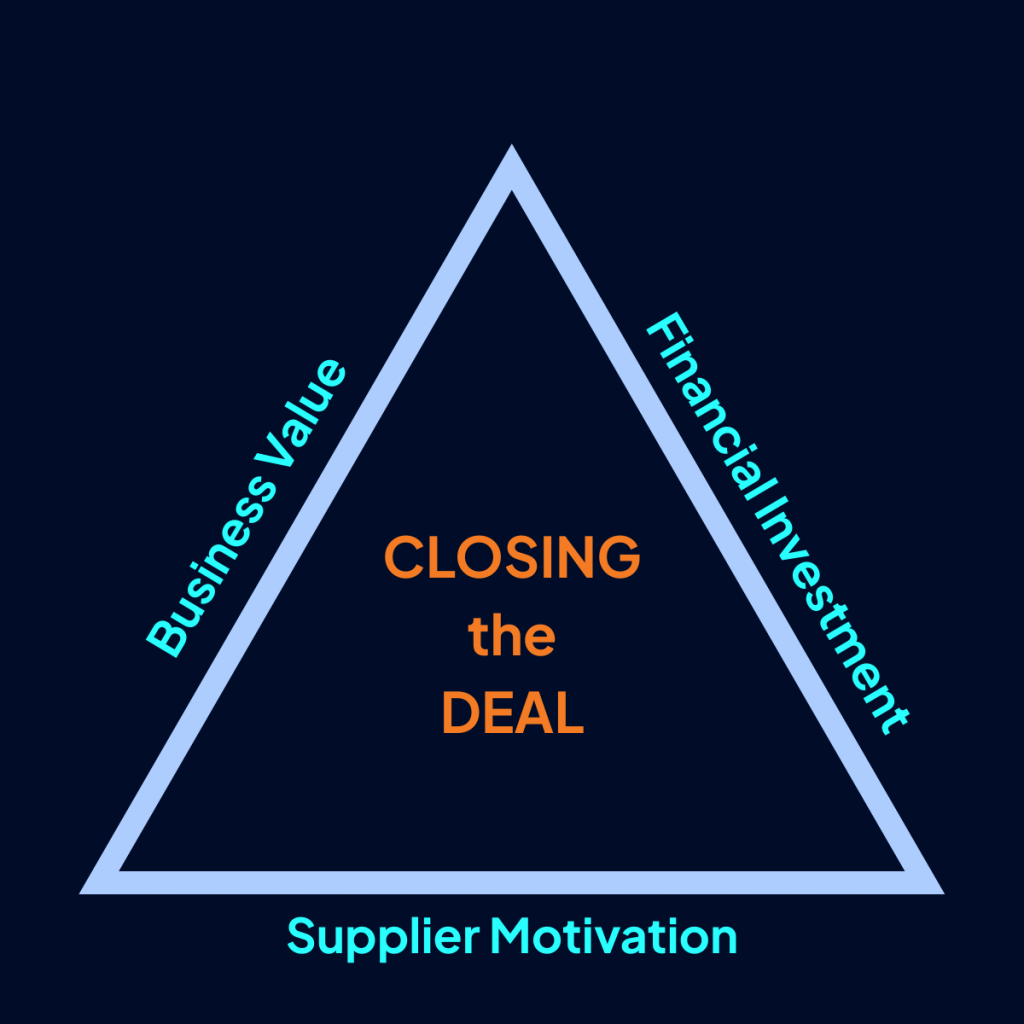
The Strategic Triangle: Balancing Value, Cost, and Motivation
Every customer enters the closing phase trying to solve a triangle of competing needs:
- Achieve the promised business value
- Optimize total financial investment
- Secure a motivated partner who will deliver
When one dimension dominates, deals weaken.
When all three are balanced, partnerships thrive.
Great closers address all three at once.
For example, an energy technology provider facing budget pressure restructured their proposal into phased delivery. The customer’s initial investment was reduced while total contract value and implementation success were preserved. This solution satisfied procurement’s constraints while keeping business and project teams aligned.¹⁴
This is closing as orchestration, not negotiation.
Closing Power Comes From Preparation, Not Pressure
The chapter makes this clear. Your negotiation power does not appear during closing.
It is built throughout the entire 4steps2win journey.
Research confirms three core sources of real closing power:
- Strong alternatives (BATNA)
- Role authority
- Psychological positioning³
These are outcomes of months of preparation carried out during Steps 1 to 3.
If the preparatory work is weak, no last-minute tactic will save you.
If the foundation is strong, closing becomes a natural progression.
Differentiation Is Your Greatest Negotiation Power
Closing conversations become difficult when your value rests on features rather than business outcomes.
The strongest negotiation power comes from clear, customer-specific differentiation that:
- Competitors cannot match
- Stakeholders understand
- Champions can promote internally
- Executive sponsors believe in
When value is vague, procurement pushes on price.
When value is concrete, procurement becomes a partner in optimisation.
Academic research shows that companies with systematic value articulation significantly outperform feature-focused suppliers.⁴ Value superiority must be recognised across the entire decision-making team for competitive wins.
Coalition Building: The Hidden Skill of Effective Closers
Great closers do not rely on a single champion.
They build a coalition that includes:
- Procurement allies who understand cost in context
- Business leaders who defend strategic impact
- Technical evaluators who support feasibility
- Project managers who trust your execution
This requires tailored value narratives for each group.
A cybersecurity provider demonstrated this by creating separate value arguments for procurement, business, and IT. Each group received the version of value that mattered most to them. The result was unified support even at a premium price.¹⁵
Objections Are Not Barriers. They Are Signals.
One of the most powerful concepts is that objections aren’t rejection signals, they’re indicators of unaddressed interests.
“Your price is too high” may actually mean:
- Our budget is fixed this quarter
- We need help getting CFO approval
- We are worried about implementation risk
- We lack internal consensus
The key is interest-based exploration, popularised by Fisher & Ury³.
Focus on the underlying interest, not the surface objection.
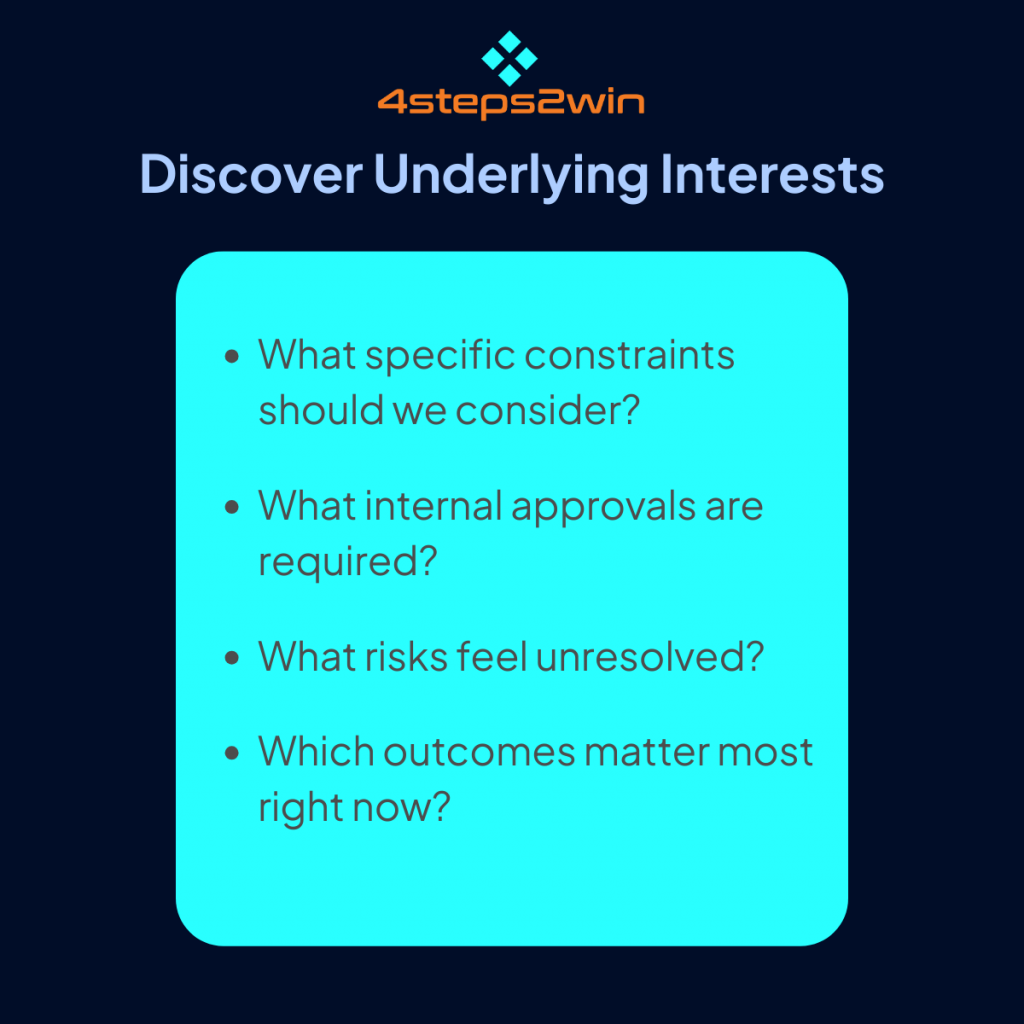
Ask questions that uncover the real issue:
- “What specific constraints should we consider”
- “What internal approvals are required”
- “What risks feel unresolved”
- “Which outcomes matter most right now”
These questions create pathways to creative collaboration.
In one case, an AI platform provider discovered that the real concern beneath a pricing objection was board risk. They restructured the deal using success-based pricing. This greatly improved confidence while preserving full contract value.¹⁶
Value Superiority: What Ultimately Wins Decisions
Harvard Business Review research confirms that “overall value superiority” is the number one driver of B2B buying decisions.⁶
Your chapter reinforces this idea clearly.
Value superiority is not a slogan. It is a system built from:
- A differentiated value story
- Clear evidence
- Validated success metrics
- Multiple stakeholder champions
- Trust built through presence, consistency, and transparency
This is why closing starts long before closing.
Negotiation Strategy: Structure Over Pressure
High-performing negotiators use structured approaches, not tricks.
Structured negotiation drives better outcomes in deal size, profitability, and relationship strength.⁹
Key practices include:
- Preparing multiple options instead of one offer
- Balancing value with customer constraints
- Using creativity to solve multiple stakeholder priorities
- Maintaining walk-away clarity
- Avoiding concessions without reciprocal commitments
Closing excellence means using structure to guide decisions, not using pressure to force them.
Implementation Starts in the Closing Phase
Implementation success begins during closing. Your final discussions should include:
- Governance structures
- Success metrics
- Communication protocols
- Resource requirements
- Escalation paths
Customers commit more confidently when they see a clear pathway to success.
Closing is not the end of the relationship.
It is the beginning of execution.
Final Thoughts: Closing as Collaborative Decision-Making
Closing the deal means transforming multi-stakeholder conflict into coordinated agreement.
You are not persuading.
You are orchestrating.
Your role is to:
- Align the strategic triangle
- Solve political and emotional concerns
- Build value superiority
- Address objections through interests
- Create confidence through preparation
- Set the foundation for implementation
This is how you turn months of work into long-term partnership success.
Thanks for Reading!
At 4steps2win, we help sales professionals master the Closing phase by turning co-created value into real customer commitment through clarity, confidence, and deliberate orchestration.
📘 Learn more
💬 Book a free consultation
References
¹ Simon-Kucher (2024). Global B2B Study: Sales Negotiation and Rebate Strategies.
² Ha, J. (2023). Customer Journey Management Capability in B2B Markets. Journal of the Academy of Marketing Science.
³ Fisher, Ury, Patton (2011). Getting to Yes. Harvard Negotiation Project.
⁴ Töytäri, Rajala (2015). Value-Based Selling. Industrial Marketing Management.
⁵ Simon-Kucher (2024). Mastering B2B Sales Negotiations.
⁶ Almquist, Cleghorn, Sherer (2018). The B2B Elements of Value. Harvard Business Review.
⁷ Gansser et al. (2021). Trust and Commitment in B2B Services. Industrial Marketing Management.
⁸ Ha, J. (2020). Trust Effects in B2B Relationships. Sustainability Journal.
⁹ Herbst, Voeth, Meister (2021). Improving Negotiation Success in B2B. Journal of Business Economics.
¹⁰ Zhang (2024). International Business Negotiation Strategies.
¹¹ Kohtamäki, Rajala (2016). Value Co-Creation Theory and Practice. Industrial Marketing Management.
¹² Ranta, Keränen, Aarikka-Stenroos (2020). Circular Economy Value Propositions. Industrial Marketing Management.
¹³ Biemans, Brencic, Malshe (2010). Marketing-Sales Interface in B2B Firms.
¹⁴ Energy Technology Case Study (2024).
¹⁵ Financial Services Multi-Stakeholder Case Study (2024).
¹⁶ AI Platform Success-Based Pricing Case Study (2024).